



If you’ve followed the evolution of electric vehicles even casually, it’s impossible to ignore the Nissan Leaf. With global sales surpassing 600,000 units, it helped define what a mass-market electric car could be. Yet that legacy also became a limitation. For many years, the Leaf was respected, but rarely desired—practical, efficient, and sensible, but emotionally distant.
Now, the all-new generation takes a bold step forward. The Leaf has abandoned its familiar hatchback form and reemerged as a compact electric SUV built on the Renault-Nissan Alliance’s CMF-EV platform. It’s not a mild refresh—it’s a complete reinvention.
The question is whether this transformation reflects confidence, or simply adaptation.
Exterior Design: Less Conservative, More Intentional
At first glance, the new Leaf barely resembles its predecessor.
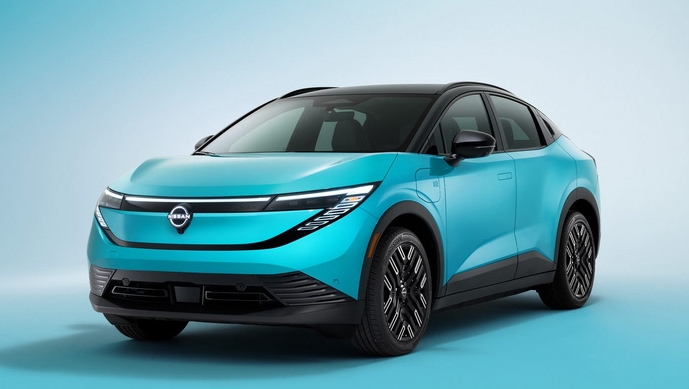
The proportions are taller and wider, clearly aligned with today’s electric SUV trends. A closed front fascia, full-width LED daytime running lights, and an illuminated Nissan badge all signal its electric identity. This is no longer a car designed to blend in quietly—it wants to be noticed.
Nissan’s featured color, Luminous Teal, captures this shift perfectly. It’s fresh, expressive, and distinctly modern, reinforcing the Leaf’s new role as a lifestyle-oriented EV rather than a purely functional commuter.
The side profile reveals a gently sloping roofline that gives the car a coupe-inspired SUV silhouette. Hidden door handles and aerodynamically optimized wheels aren’t just visual tricks—they contribute directly to efficiency. Nissan claims a drag coefficient of 0.25 for the European version and 0.26 for U.S. and Japanese models, an impressive figure for a vehicle of this shape.
Interior: Finally Designed for People, Not Just Engineers
The interior is where the Leaf’s transformation becomes most apparent.
Previous generations focused heavily on function, often at the expense of warmth or character. The new model feels intentionally designed for everyday life. Two 14.3-inch displays dominate the dashboard, combining the instrument cluster and infotainment system into a clean, modern layout. Navigation, media, apps, and remote services are seamlessly integrated.
Physical clutter is kept to a minimum, with electronic shift controls, a head-up display, wireless phone charging, and a panoramic electrochromic glass roof creating a calm, high-tech environment. Nissan’s choice of a BOSE sound system with headrest-mounted speakers is a thoughtful touch, especially for long commutes and road trips.
Rather than chasing flashy trends, the cabin focuses on long-term comfort and usability—a subtle but important distinction.
Performance and Range: Quietly Confident
The new Leaf doesn’t aim to impress with extreme performance figures, but its numbers are more than competitive in the compact electric SUV segment.
Key Performance Specifications
| Specification | New Nissan Leaf |
|---|---|
| Maximum Power | 160 kW (approx. 218 hp) |
| Peak Torque | 355 Nm |
| Drivetrain | Front-wheel drive |
| Estimated Driving Range | Up to 604 km |
| Fast Charging | ~250 km added in 14 minutes |
| Suspension | Front MacPherson / Rear multi-link |
| Turning Radius | 5.3 meters |
The newly developed three-in-one electric motor prioritizes efficiency and smooth delivery rather than aggressive acceleration. Combined with its low drag coefficient, the Leaf achieves a driving range that comfortably exceeds 600 kilometers, addressing one of the most persistent concerns among EV buyers.
The inclusion of V2X bidirectional charging adds practical versatility, allowing the vehicle to power external devices during emergencies or outdoor activities—an increasingly valuable feature for family-oriented users.
Pricing Outlook: Positioned for Rational Buyers
Official pricing has yet to be announced, but based on platform positioning and Nissan’s historical strategy, a reasonable estimate can be made.
Estimated Price Range (USD)
| Version | Estimated Price |
|---|---|
| Standard Range | $33,000 – $36,000 |
| Long-Range / Higher Trim | $37,000 – $40,000 |
This places the new Leaf squarely in the heart of the mainstream electric SUV market. It’s not chasing premium brand status, nor is it competing solely on price. Instead, it targets buyers who want reliability, efficiency, and proven engineering without paying for unnecessary prestige.
Who Is This New Leaf Really For?
This SUV-style Leaf knows exactly where it stands.
It will appeal most to drivers who value range, practicality, and overall balance. Families who don’t need a large SUV, urban commuters who also enjoy weekend trips, and buyers who want a dependable EV without dramatic compromises will find it particularly attractive.
It’s less likely to satisfy those seeking high-performance thrills, strong brand signaling, or a tech-centric “gadget” experience. The Leaf remains a grounded, thoughtful product—and that’s precisely its strength.
Editor’s Take: A Sensible Reinvention at the Right Time
Transforming the Leaf from a hatchback into a compact electric SUV isn’t a rejection of its past—it’s an acknowledgment of the market’s reality. Being an early pioneer is no longer enough. Today’s buyers expect usability, style, and confidence in equal measure.
Rather than reinventing the electric vehicle once again, Nissan has refined what it already does best, packaging over a decade of EV experience into a form that aligns with modern expectations.
When preorders open in late 2025 and deliveries begin in early 2026, the new Leaf may not dominate headlines. But it has every chance to become a quiet, consistent success—exactly the kind of car many people end up choosing when the excitement fades and real-world needs take over.
In today’s intensely competitive EV landscape, that may be the most meaningful achievement of all.