


Battery Degradation vs Mechanical Wear
When people talk about long-term vehicle ownership, electric cars are often criticized for battery degradation, while gasoline cars are assumed to age more gracefully. In reality, these two vehicle types degrade in very different ways.
Electric vehicles lose some usable battery capacity over time, but this process is typically slow and predictable. Most high-mileage EVs still retain around 85–90% of their original capacity after 150,000 miles. For many owners, this results in reduced range rather than a loss of usability.
Gasoline vehicles, by contrast, experience ongoing mechanical wear. Engines, transmissions, fuel systems, and exhaust components all degrade continuously with mileage, often without a clear timeline for failure.
The Hidden Cost Curve of Gasoline Cars
As mileage increases, gasoline vehicles tend to accumulate costs across many systems. Oil-related engine wear, transmission servicing, fuel injectors, turbochargers, and emissions components often begin to fail independently of one another.
While each repair may seem manageable on its own, the combined cost over 100,000 to 150,000 miles can easily reach several thousand dollars. More importantly, these expenses are often unpredictable, making long-term ownership harder to plan.
Why EV Maintenance Looks Different
Electric vehicles eliminate many traditional wear items entirely. There are no oil changes, no multi-gear transmissions, and no exhaust systems. Regenerative braking further reduces brake wear, keeping routine maintenance costs relatively low even at high mileage.
Battery replacement is often cited as the EV’s biggest long-term risk, but real-world data suggests that complete battery failure remains rare. Most degradation results in gradual capacity loss rather than sudden failure, and battery warranties provide additional protection during the early years of ownership.
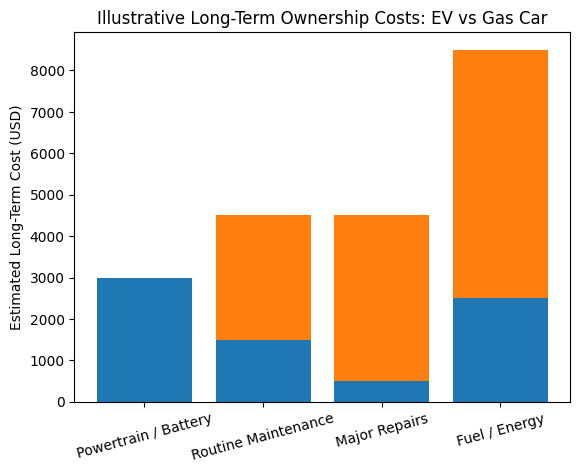
📊 Illustrative Long-Term Ownership Costs: EV vs Gas Car
(Cost structure comparison based on real-world ownership trends)
Which Type Actually Costs More Over Time?
When long-term ownership is viewed through total cost rather than isolated components, the comparison becomes clearer. EVs experience measurable but predictable battery degradation, while gasoline cars accumulate ongoing mechanical wear across multiple systems.
One form of degradation reduces range gradually. The other introduces increasing maintenance risk and rising repair costs. As more vehicles reach high mileage, it is becoming clear that battery degradation alone does not necessarily make EVs more expensive to own over time.
The Bigger Picture for Long-Term Owners
As the used vehicle market evolves, buyers are beginning to evaluate cars based on total cost stability rather than isolated concerns. The question is no longer whether EVs degrade, but whether that degradation actually costs more than the cumulative wear of traditional engines.
For a growing number of owners, the data suggests the answer is no.