



Reaching the 100,000-Mile Milestone
Reaching 100,000 miles has long been a psychological milestone in car ownership. Gasoline vehicles often reach this point with rising maintenance costs and growing reliability concerns. Electric vehicles raise a different question: what does ownership actually look like once the odometer reaches six figures?
Real-world owner reports and high-mileage data suggest the experience is far less dramatic than many people expect.
How Battery Degradation Feels in Daily Driving
Battery capacity is usually the most noticeable change after 100,000 miles. Even so, the impact remains modest for most drivers. Many EVs at this mileage still retain roughly 88–95% of their original usable capacity. In everyday driving, this reduction usually means fewer available miles, not a change in how the vehicle is used.
Seeing this trend visually helps explain why many owners remain unconcerned. Battery degradation tends to drop slightly early on, then settle into a long period of slow and predictable decline.
📊 Typical EV Battery Capacity Over 100,000 Miles
(illustrative real-world trend based on high-mileage EV data
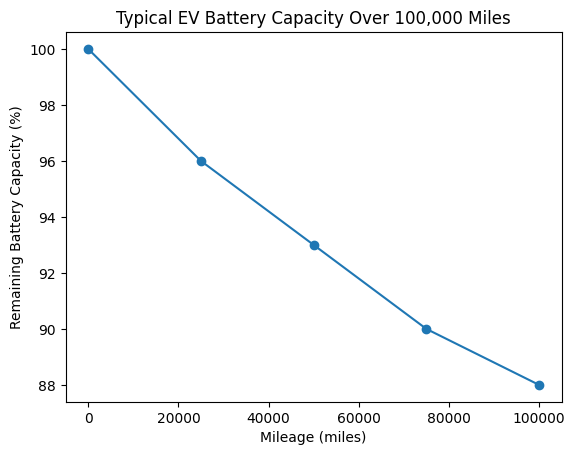
While individual results vary, real-world data consistently shows this general pattern of battery degradation.
What Doesn’t Change After 100,000 Miles
What surprises many owners is how little else changes. Electric drivetrains remain mechanically simple even at high mileage. Most EVs continue running on their original motors, inverters, and battery packs well past the 100,000-mile mark.
Drivers do not experience worsening vibrations, rough shifting, or exhaust-related issues. The vehicle often feels much like it did years earlier, aside from a slightly reduced maximum range.
Maintenance and Reliability Over Time
Maintenance looks very different for EVs at this stage. There are no oil changes, spark plugs, or emissions systems to service. Regenerative braking also reduces brake wear, allowing many owners to reach 100,000 miles on their original brake components.
Charging habits also stabilize over time. Long-term owners tend to rely on home or workplace charging and use fast chargers only when necessary. This consistency reduces stress and supports long-term battery health.
Major reliability concerns remain rare at this mileage. Battery replacement receives the most attention, but real-world data shows that full battery failures remain uncommon. Degradation happens gradually, giving owners time to adapt rather than forcing sudden decisions.
The Psychological Shift of Long-Term EV Ownership
After 100,000 miles, many EV owners report a shift in mindset. Early concerns about battery life and durability fade as real experience replaces speculation. Ownership becomes more predictable, not more stressful.
Owning an EV after 100,000 miles rarely involves a dramatic turning point. Instead, it reveals a vehicle that continues to meet daily needs with fewer mechanical complications than many expected. As more EVs pass this milestone, that experience is becoming increasingly normal.