



Battery degradation remains one of the most persistent concerns around electric vehicles. For many skeptics, the assumption is simple: electric cars might work fine when new, but once the mileage climbs into six figures, range loss becomes a serious problem. The growing body of real-world data from high-mileage EVs, however, suggests that this fear is largely overstated.Real-world data from high-mileage EVs shows that EV range loss is far more gradual than many drivers expect.
Looking at vehicles that have accumulated around 100,000 miles, most electric cars still retain roughly 88 to 95 percent of their original battery capacity. In practical terms, that means a real-world range reduction of about 5 to 12 percent. Even cars that have crossed 150,000 miles often remain in the 80 to 88 percent range, depending on climate and charging behavior. A 300-mile EV dropping to around 275 miles may sound significant on paper, but for most daily driving scenarios, the difference is far less dramatic than expected.
That overall trend becomes easier to understand when visualized. High-mileage EV data consistently shows an early drop in capacity, followed by a long period of much slower degradation as mileage continues to increase.
📊 Typical EV Battery Capacity vs. Mileage
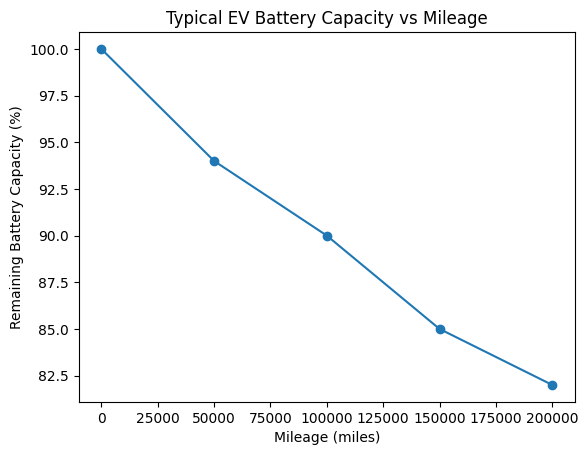
What stands out in these datasets is that battery degradation does not continue at a steady pace. Instead, many EVs experience a modest initial drop in capacity—typically within the first one or two years—followed by a long period of relative stability. After that early phase, annual range loss often slows to well under one percent per year. This explains why an EV with 60,000 miles and one with 120,000 miles can feel surprisingly similar in everyday use.
Another common assumption is that high mileage alone is the primary cause of battery wear, but the data doesn’t fully support that idea. Charging habits and operating conditions appear to play a larger role. Vehicles that are driven regularly, charged mostly at home on AC power, and kept out of extreme heat tend to age more gracefully than lower-mileage EVs that rely heavily on fast charging. In several cases, higher-mileage cars with conservative charging routines outperform lower-mileage vehicles that have seen frequent DC fast charging.
For most owners, the real-world impact of this gradual degradation is minimal. A commuter driving 30 to 40 miles per day is unlikely to notice a meaningful difference between 280 miles of range and 255 miles. As long as the vehicle started with a reasonable range buffer, daily usability often remains unchanged even after years of ownership.
This has important implications for the used EV market. High mileage is no longer an automatic red flag. Battery health has become more predictable and easier to evaluate, and catastrophic range loss is far less common than early narratives suggested. Many high-mileage EVs continue to operate on their original battery packs while meeting their owners’ needs without compromise.
As more electric vehicles pass the 100,000- and even 200,000-mile marks, the picture is becoming clearer. Battery degradation exists, but it is gradual, manageable, and often far less impactful than people assume. Real-world data is steadily replacing speculation, and it tells a much calmer story about the long-term viability of electric cars.